
抱歉,您的浏览器无法访问本站
本页面需要浏览器支持(启用)JavaScript
了解详情 >

其实在此之前我就大概知道,stack unwinding 是反向回溯栈的一种机制,在 throw 了什么东西后一层层回溯栈,一层层析构掉这些栈上的 RAII 对象,直到找到 try catch 块后跳转到 catch 块。

但是问题是这种事情是怎样实现的?多说无益,我们直接从 throw 的源码入手分析。

首先我们编写一段示例代码:

1
2
3
4
5
6
7
8
9
10
11
12
13
14
15
16
17
18
19
20
21
22
23
24
25
26
27
28
29
30
31
#include <iostream>
#include <string>

void func2();

void func1() {
std::cout << "Hello" << std::endl;
func2();
}

void func2() {
std::cout << "World" << std::endl;
throw std::string("C++");
}

int main() {
try {
std::string s1 = "Hello";

{
std::string s2 = "World";
}

std::string s3 = "Stack Unwinding";

func1();
} catch (const std::string& e) {
std::cout << e << std::endl;
}
return 0;
}

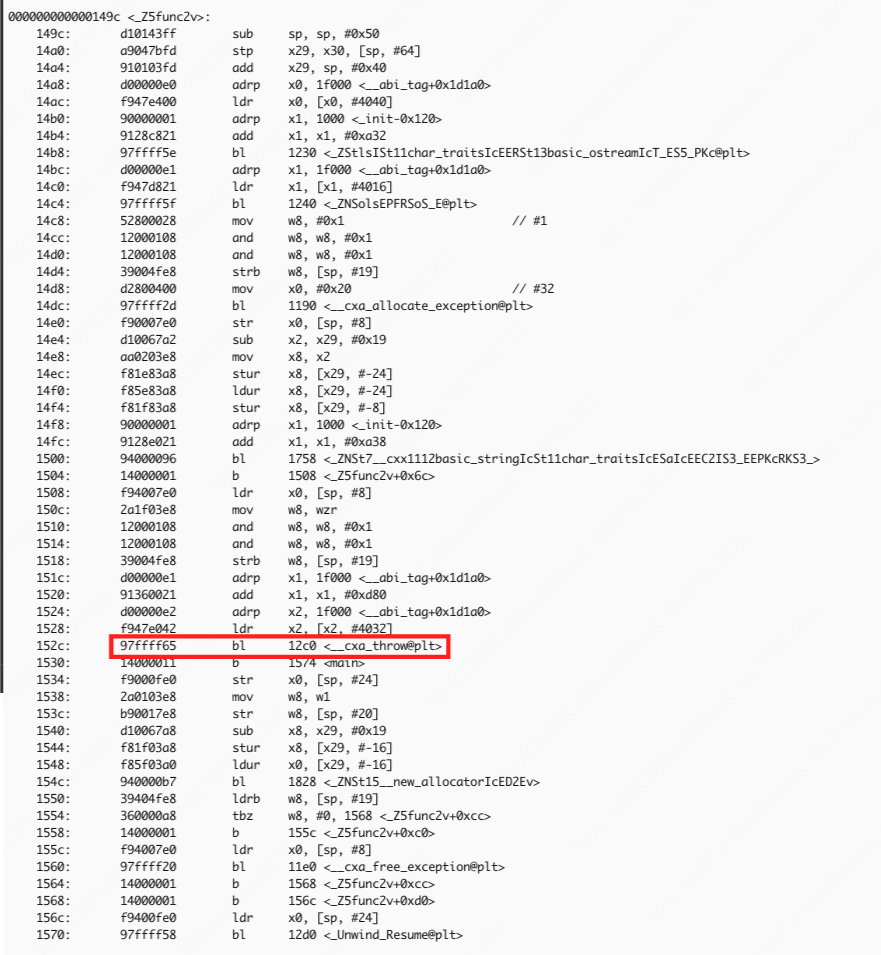
编译后使用 objdump -d 看 func2 的内容,发现 throw 被编译成了 __cxa_throw 调用:
image

__cxa_throw

__cxa_throw 位于 llvm 的 libcxxabi 子项目中:

1
2
3
4
5
6
7
8
9
10
11
12
13
14
15
16
17
18
19
20
21
22
23
24
25
26
27
void
#ifdef __wasm__
// In Wasm, a destructor returns its argument
__cxa_throw(void *thrown_object, std::type_info *tinfo, void *(_LIBCXXABI_DTOR_FUNC *dest)(void *)) {
#else
__cxa_throw(void *thrown_object, std::type_info *tinfo, void (_LIBCXXABI_DTOR_FUNC *dest)(void *)) {
#endif
__cxa_eh_globals* globals = __cxa_get_globals();
globals->uncaughtExceptions += 1; // Not atomically, since globals are thread-local

__cxa_exception* exception_header = __cxa_init_primary_exception(thrown_object, tinfo, dest);
exception_header->referenceCount = 1; // This is a newly allocated exception, no need for thread safety.

#if __has_feature(address_sanitizer)
// Inform the ASan runtime that now might be a good time to clean stuff up.
__asan_handle_no_return();
#endif

#ifdef __USING_SJLJ_EXCEPTIONS__
_Unwind_SjLj_RaiseException(&exception_header->unwindHeader);
#else
_Unwind_RaiseException(&exception_header->unwindHeader);
#endif
// This only happens when there is no handler, or some unexpected unwinding
// error happens.
failed_throw(exception_header);
}

能看出来其核心实现在 _Unwind_RaiseException

_Unwind_RaiseException

在 libunwind 子项目中找到其实现:

1
2
3
4
5
6
7
8
9
10
11
12
13
14
15
16
17
18
19
20
21
22
23
/// Called by __cxa_throw.  Only returns if there is a fatal error.
_LIBUNWIND_EXPORT _Unwind_Reason_Code
_Unwind_RaiseException(_Unwind_Exception *exception_object) {
_LIBUNWIND_TRACE_API("_Unwind_RaiseException(ex_obj=%p)",
(void *)exception_object);
unw_context_t uc;
unw_cursor_t cursor;
__unw_getcontext(&uc);

// Mark that this is a non-forced unwind, so _Unwind_Resume()
// can do the right thing.
exception_object->private_1 = 0;
exception_object->private_2 = 0;

// phase 1: the search phase
_Unwind_Reason_Code phase1 = unwind_phase1(&uc, &cursor, exception_object);
if (phase1 != _URC_NO_REASON)
return phase1;

// phase 2: the clean up phase
return unwind_phase2(&uc, &cursor, exception_object);
}

这里我们可以发现有两个 phase:

search phase

1
2
3
4
5
6
7
8
9
10
11
12
13
14
15
16
17
18
19
20
21
22
23
24
25
26
27
28
29
30
31
32
33
34
35
36
37
38
39
40
41
42
43
44
45
46
47
48
49
50
51
52
53
54
55
56
57
58
59
60
61
62
63
64
65
66
67
68
69
70
71
72
73
74
75
76
77
78
79
80
81
82
83
84
85
86
87
88
89
90
91
92
93
static _Unwind_Reason_Code
unwind_phase1(unw_context_t *uc, unw_cursor_t *cursor, _Unwind_Exception *exception_object) {
__unw_init_local(cursor, uc);

// Walk each frame looking for a place to stop.
while (true) {
// Ask libunwind to get next frame (skip over first which is
// _Unwind_RaiseException).
int stepResult = __unw_step(cursor);
if (stepResult == 0) {
_LIBUNWIND_TRACE_UNWINDING(
"unwind_phase1(ex_obj=%p): __unw_step() reached "
"bottom => _URC_END_OF_STACK",
(void *)exception_object);
return _URC_END_OF_STACK;
} else if (stepResult < 0) {
_LIBUNWIND_TRACE_UNWINDING(
"unwind_phase1(ex_obj=%p): __unw_step failed => "
"_URC_FATAL_PHASE1_ERROR",
(void *)exception_object);
return _URC_FATAL_PHASE1_ERROR;
}

// See if frame has code to run (has personality routine).
unw_proc_info_t frameInfo;
unw_word_t sp;
if (__unw_get_proc_info(cursor, &frameInfo) != UNW_ESUCCESS) {
_LIBUNWIND_TRACE_UNWINDING(
"unwind_phase1(ex_obj=%p): __unw_get_proc_info "
"failed => _URC_FATAL_PHASE1_ERROR",
(void *)exception_object);
return _URC_FATAL_PHASE1_ERROR;
}

#ifndef NDEBUG
// When tracing, print state information.
if (_LIBUNWIND_TRACING_UNWINDING) {
char functionBuf[512];
const char *functionName = functionBuf;
unw_word_t offset;
if ((__unw_get_proc_name(cursor, functionBuf, sizeof(functionBuf),
&offset) != UNW_ESUCCESS) ||
(frameInfo.start_ip + offset > frameInfo.end_ip))
functionName = ".anonymous.";
unw_word_t pc;
__unw_get_reg(cursor, UNW_REG_IP, &pc);
_LIBUNWIND_TRACE_UNWINDING(
"unwind_phase1(ex_obj=%p): pc=0x%" PRIxPTR ", start_ip=0x%" PRIxPTR
", func=%s, lsda=0x%" PRIxPTR ", personality=0x%" PRIxPTR "",
(void *)exception_object, pc, frameInfo.start_ip, functionName,
frameInfo.lsda, frameInfo.handler);
}
#endif

// If there is a personality routine, ask it if it will want to stop at
// this frame.
if (frameInfo.handler != 0) {
_Unwind_Personality_Fn p = get_handler_function(&frameInfo);
_LIBUNWIND_TRACE_UNWINDING(
"unwind_phase1(ex_obj=%p): calling personality function %p",
(void *)exception_object, (void *)(uintptr_t)p);
_Unwind_Reason_Code personalityResult =
(*p)(1, _UA_SEARCH_PHASE, exception_object->exception_class,
exception_object, (struct _Unwind_Context *)(cursor));
switch (personalityResult) {
case _URC_HANDLER_FOUND:
// found a catch clause or locals that need destructing in this frame
// stop search and remember stack pointer at the frame
__unw_get_reg(cursor, UNW_REG_SP, &sp);
exception_object->private_2 = (uintptr_t)sp;
_LIBUNWIND_TRACE_UNWINDING(
"unwind_phase1(ex_obj=%p): _URC_HANDLER_FOUND",
(void *)exception_object);
return _URC_NO_REASON;

case _URC_CONTINUE_UNWIND:
_LIBUNWIND_TRACE_UNWINDING(
"unwind_phase1(ex_obj=%p): _URC_CONTINUE_UNWIND",
(void *)exception_object);
// continue unwinding
break;

default:
// something went wrong
_LIBUNWIND_TRACE_UNWINDING(
"unwind_phase1(ex_obj=%p): _URC_FATAL_PHASE1_ERROR",
(void *)exception_object);
return _URC_FATAL_PHASE1_ERROR;
}
}
}
return _URC_NO_REASON;
}
  • 向下找一个栈帧

  • 通过查表(.eh_frame_hdr)获取这个栈帧的 FDE 头

search phase 比较好理解,一次只往下找一个栈,如果找到了 catch clause 或者需要析构的 RAII 对象,则会返回 _URC_NO_REASON,只有 search phase 返回 _URC_NO_REASON 才会继续向下走到 clean up phase。

__unw_step

1
2
3
4
5
6
7
8
9
10
11
12
13
14
15
16
17
18
19
20
21
22
23
24
25
26
27
28
29
30
31
32
33
34
35
36
37
38
39
40
41
42
43
44
45
46
47
48
49
50
51
52
53
54
55
56
57
58
59
60
61
62
63
64
65
66
67
68
69
70
71
72
/// Move cursor to next frame.
_LIBUNWIND_HIDDEN int __unw_step(unw_cursor_t *cursor) {
_LIBUNWIND_TRACE_API("__unw_step(cursor=%p)", static_cast<void *>(cursor));
AbstractUnwindCursor *co = (AbstractUnwindCursor *)cursor;
return co->step();
}
_LIBUNWIND_WEAK_ALIAS(__unw_step, unw_step)

template <typename A, typename R> int UnwindCursor<A, R>::step(bool stage2) {
(void)stage2;
// Bottom of stack is defined is when unwind info cannot be found.
if (_unwindInfoMissing)
return UNW_STEP_END;

// Use unwinding info to modify register set as if function returned.
int result;
#if defined(_LIBUNWIND_CHECK_LINUX_SIGRETURN) || \
defined(_LIBUNWIND_CHECK_HAIKU_SIGRETURN)
if (_isSigReturn) {
result = this->stepThroughSigReturn();
} else
#endif
{
#if defined(_LIBUNWIND_SUPPORT_COMPACT_UNWIND)
result = this->stepWithCompactEncoding(stage2);
#elif defined(_LIBUNWIND_SUPPORT_SEH_UNWIND)
result = this->stepWithSEHData();
#elif defined(_LIBUNWIND_SUPPORT_TBTAB_UNWIND)
result = this->stepWithTBTableData();
#elif defined(_LIBUNWIND_SUPPORT_DWARF_UNWIND)
result = this->stepWithDwarfFDE(stage2);
#elif defined(_LIBUNWIND_ARM_EHABI)
result = this->stepWithEHABI();
#else
#error Need _LIBUNWIND_SUPPORT_COMPACT_UNWIND or \
_LIBUNWIND_SUPPORT_SEH_UNWIND or \
_LIBUNWIND_SUPPORT_DWARF_UNWIND or \
_LIBUNWIND_ARM_EHABI
#endif
}

// update info based on new PC
if (result == UNW_STEP_SUCCESS) {
this->setInfoBasedOnIPRegister(true);
if (_unwindInfoMissing)
return UNW_STEP_END;
}

return result;
}

// linux 标准
#if defined(_LIBUNWIND_SUPPORT_DWARF_UNWIND)
bool getInfoFromFdeCie(const typename CFI_Parser<A>::FDE_Info &fdeInfo,
const typename CFI_Parser<A>::CIE_Info &cieInfo,
pint_t pc, uintptr_t dso_base);
bool getInfoFromDwarfSection(const typename R::link_reg_t &pc,
const UnwindInfoSections &sects,
uint32_t fdeSectionOffsetHint = 0);
int stepWithDwarfFDE(bool stage2) {
#if defined(_LIBUNWIND_TARGET_AARCH64_AUTHENTICATED_UNWINDING)
typename R::reg_t rawPC = this->getReg(UNW_REG_IP);
typename R::link_reg_t pc;
_registers.loadAndAuthenticateLinkRegister(rawPC, &pc);
#else
typename R::link_reg_t pc = this->getReg(UNW_REG_IP);
#endif
return DwarfInstructions<A, R>::stepWithDwarf(
_addressSpace, pc, (pint_t)_info.unwind_info, _registers,
_isSignalFrame, stage2);
}
#endif

_unw_step 这个函数的实际逻辑最后定位到了 libunwind 的 stepWithDwarfFDE(这是 linux 上的实现)。

  • 首先会从栈帧上拿到保存的 ip (instruction pointer,即函数的返回地址)

  • 然后调用 DwarfInstructions::stepWithDwarf:

1
2
3
4
5
6
7
8
9
10
11
12
13
14
15
16
17
18
19
20
21
22
23
24
25
26
27
28
29
30
31
32
33
34
35
36
37
38
39
40
41
42
43
44
45
46
47
48
49
50
51
52
53
54
55
56
57
58
59
60
61
62
63
64
65
66
67
68
69
70
71
72
73
74
75
76
77
78
79
80
81
82
83
84
85
86
87
88
89
90
91
92
93
94
95
96
97
98
99
100
101
102
103
104
105
106
107
108
109
110
111
112
113
114
115
116
117
118
119
120
121
122
123
124
125
126
127
128
129
130
131
132
133
134
135
136
137
138
139
140
141
142
143
144
145
146
147
148
149
150
151
152
153
154
155
156
157
158
159
160
161
162
163
164
165
166
167
168
169
170
171
172
173
174
175
176
177
178
179
180
181
182
183
184
185
186
187
188
189
190
191
192
193
194
195
196
197
198
199
200
201
202
203
204
205
206
207
208
209
210
211
212
213
214
template <typename A, typename R>
int DwarfInstructions<A, R>::stepWithDwarf(A &addressSpace,
const typename R::link_reg_t &pc,
pint_t fdeStart, R &registers,
bool &isSignalFrame, bool stage2) {
FDE_Info fdeInfo;
CIE_Info cieInfo;
if (CFI_Parser<A>::decodeFDE(addressSpace, fdeStart, &fdeInfo,
&cieInfo) == NULL) {
PrologInfo prolog;
if (CFI_Parser<A>::parseFDEInstructions(addressSpace, fdeInfo, cieInfo, pc,
R::getArch(), &prolog)) {
// get pointer to cfa (architecture specific)
pint_t cfa = getCFA(addressSpace, prolog, registers);

(void)stage2;
// __unw_step_stage2 is not used for cross unwinding, so we use
// __aarch64__ rather than LIBUNWIND_TARGET_AARCH64 to make sure we are
// building for AArch64 natively.
#if defined(__aarch64__)
if (stage2 && cieInfo.mteTaggedFrame) {
pint_t sp = registers.getSP();
pint_t p = sp;
// AArch64 doesn't require the value of SP to be 16-byte aligned at
// all times, only at memory accesses and public interfaces [1]. Thus,
// a signal could arrive at a point where SP is not aligned properly.
// In that case, the kernel fixes up [2] the signal frame, but we
// still have a misaligned SP in the previous frame. If that signal
// handler caused stack unwinding, we would have an unaligned SP.
// We do not need to fix up the CFA, as that is the SP at a "public
// interface".
// [1]:
// https://github.com/ARM-software/abi-aa/blob/main/aapcs64/aapcs64.rst#622the-stack
// [2]:
// https://github.com/torvalds/linux/blob/1930a6e739c4b4a654a69164dbe39e554d228915/arch/arm64/kernel/signal.c#L718
p &= ~0xfULL;
// CFA is the bottom of the current stack frame.
for (; p < cfa; p += 16) {
__asm__ __volatile__(".arch armv8.5-a\n"
".arch_extension memtag\n"
"stg %[Ptr], [%[Ptr]]\n"
:
: [Ptr] "r"(p)
: "memory");
}
}
#endif
// restore registers that DWARF says were saved
R newRegisters = registers;

// Typically, the CFA is the stack pointer at the call site in
// the previous frame. However, there are scenarios in which this is not
// true. For example, if we switched to a new stack. In that case, the
// value of the previous SP might be indicated by a CFI directive.
//
// We set the SP here to the CFA, allowing for it to be overridden
// by a CFI directive later on.
newRegisters.setSP(cfa);

typename R::reg_t returnAddress = 0;
constexpr int lastReg = R::lastDwarfRegNum();
static_assert(static_cast<int>(CFI_Parser<A>::kMaxRegisterNumber) >=
lastReg,
"register range too large");
assert(lastReg >= (int)cieInfo.returnAddressRegister &&
"register range does not contain return address register");
for (int i = 0; i <= lastReg; ++i) {
if (prolog.savedRegisters[i].location !=
CFI_Parser<A>::kRegisterUnused) {
if (registers.validFloatRegister(i))
newRegisters.setFloatRegister(
i, getSavedFloatRegister(addressSpace, registers, cfa,
prolog.savedRegisters[i]));
else if (registers.validVectorRegister(i))
newRegisters.setVectorRegister(
i, getSavedVectorRegister(addressSpace, registers, cfa,
prolog.savedRegisters[i]));
else if (i == (int)cieInfo.returnAddressRegister)
returnAddress = getSavedRegister(addressSpace, registers, cfa,
prolog.savedRegisters[i]);
else if (registers.validRegister(i))
newRegisters.setRegister(
i, getSavedRegister(addressSpace, registers, cfa,
prolog.savedRegisters[i]));
else
return UNW_EBADREG;
} else if (i == (int)cieInfo.returnAddressRegister) {
// Leaf function keeps the return address in register and there is no
// explicit instructions how to restore it.
returnAddress = registers.getRegister(cieInfo.returnAddressRegister);
}
}

isSignalFrame = cieInfo.isSignalFrame;

#if defined(_LIBUNWIND_TARGET_AARCH64) && \
!defined(_LIBUNWIND_TARGET_AARCH64_AUTHENTICATED_UNWINDING)
// There are two ways of return address signing: pac-ret (enabled via
// -mbranch-protection=pac-ret) and ptrauth-returns (enabled as part of
// Apple's arm64e or experimental pauthtest ABI on Linux). The code
// below handles signed RA for pac-ret, while ptrauth-returns uses
// different logic.
// TODO: unify logic for both cases, see
// https://github.com/llvm/llvm-project/issues/160110
//
// If the target is aarch64 then the return address may have been signed
// using the v8.3 pointer authentication extensions. The original
// return address needs to be authenticated before the return address is
// restored. autia1716 is used instead of autia as autia1716 assembles
// to a NOP on pre-v8.3a architectures.
if ((R::getArch() == REGISTERS_ARM64) &&
isReturnAddressSigned(addressSpace, registers, cfa, prolog) &&
returnAddress != 0) {
#if !defined(_LIBUNWIND_IS_NATIVE_ONLY)
return UNW_ECROSSRASIGNING;
#else
register unsigned long long x17 __asm("x17") = returnAddress;
register unsigned long long x16 __asm("x16") = cfa;

// We use the hint versions of the authentication instructions below to
// ensure they're assembled by the compiler even for targets with no
// FEAT_PAuth/FEAT_PAuth_LR support.
if (isReturnAddressSignedWithPC(addressSpace, registers, cfa, prolog)) {
register unsigned long long x15 __asm("x15") =
prolog.ptrAuthDiversifier;
if (cieInfo.addressesSignedWithBKey) {
asm("hint 0x27\n\t" // pacm
"hint 0xe"
: "+r"(x17)
: "r"(x16), "r"(x15)); // autib1716
} else {
asm("hint 0x27\n\t" // pacm
"hint 0xc"
: "+r"(x17)
: "r"(x16), "r"(x15)); // autia1716
}
} else {
if (cieInfo.addressesSignedWithBKey)
asm("hint 0xe" : "+r"(x17) : "r"(x16)); // autib1716
else
asm("hint 0xc" : "+r"(x17) : "r"(x16)); // autia1716
}
returnAddress = x17;
#endif
}
#endif

#if defined(_LIBUNWIND_IS_NATIVE_ONLY) && defined(_LIBUNWIND_TARGET_ARM) && \
defined(__ARM_FEATURE_PAUTH)
if ((R::getArch() == REGISTERS_ARM) &&
prolog.savedRegisters[UNW_ARM_RA_AUTH_CODE].value) {
pint_t pac =
getSavedRegister(addressSpace, registers, cfa,
prolog.savedRegisters[UNW_ARM_RA_AUTH_CODE]);
__asm__ __volatile__("autg %0, %1, %2"
:
: "r"(pac), "r"(returnAddress), "r"(cfa)
:);
}
#endif

#if defined(_LIBUNWIND_TARGET_SPARC)
if (R::getArch() == REGISTERS_SPARC) {
// Skip call site instruction and delay slot
returnAddress += 8;
// Skip unimp instruction if function returns a struct
if ((addressSpace.get32(returnAddress) & 0xC1C00000) == 0)
returnAddress += 4;
}
#endif

#if defined(_LIBUNWIND_TARGET_SPARC64)
// Skip call site instruction and delay slot.
if (R::getArch() == REGISTERS_SPARC64)
returnAddress += 8;
#endif

#if defined(_LIBUNWIND_TARGET_PPC64)
#define PPC64_ELFV1_R2_LOAD_INST_ENCODING 0xe8410028u // ld r2,40(r1)
#define PPC64_ELFV1_R2_OFFSET 40
#define PPC64_ELFV2_R2_LOAD_INST_ENCODING 0xe8410018u // ld r2,24(r1)
#define PPC64_ELFV2_R2_OFFSET 24
// If the instruction at return address is a TOC (r2) restore,
// then r2 was saved and needs to be restored.
// ELFv2 ABI specifies that the TOC Pointer must be saved at SP + 24,
// while in ELFv1 ABI it is saved at SP + 40.
if (R::getArch() == REGISTERS_PPC64 && returnAddress != 0) {
pint_t sp = newRegisters.getRegister(UNW_REG_SP);
pint_t r2 = 0;
switch (addressSpace.get32(returnAddress)) {
case PPC64_ELFV1_R2_LOAD_INST_ENCODING:
r2 = addressSpace.get64(sp + PPC64_ELFV1_R2_OFFSET);
break;
case PPC64_ELFV2_R2_LOAD_INST_ENCODING:
r2 = addressSpace.get64(sp + PPC64_ELFV2_R2_OFFSET);
break;
}
if (r2)
newRegisters.setRegister(UNW_PPC64_R2, r2);
}
#endif

// Return address is address after call site instruction, so setting IP to
// that does simulates a return.
newRegisters.setIP(returnAddress);

// Simulate the step by replacing the register set with the new ones.
registers = newRegisters;

return UNW_STEP_SUCCESS;
}
}
return UNW_EBADFRAME;
}

看着虽然长,但有很多是在抹平指令集的平台差异,实际的逻辑还算比较清晰:

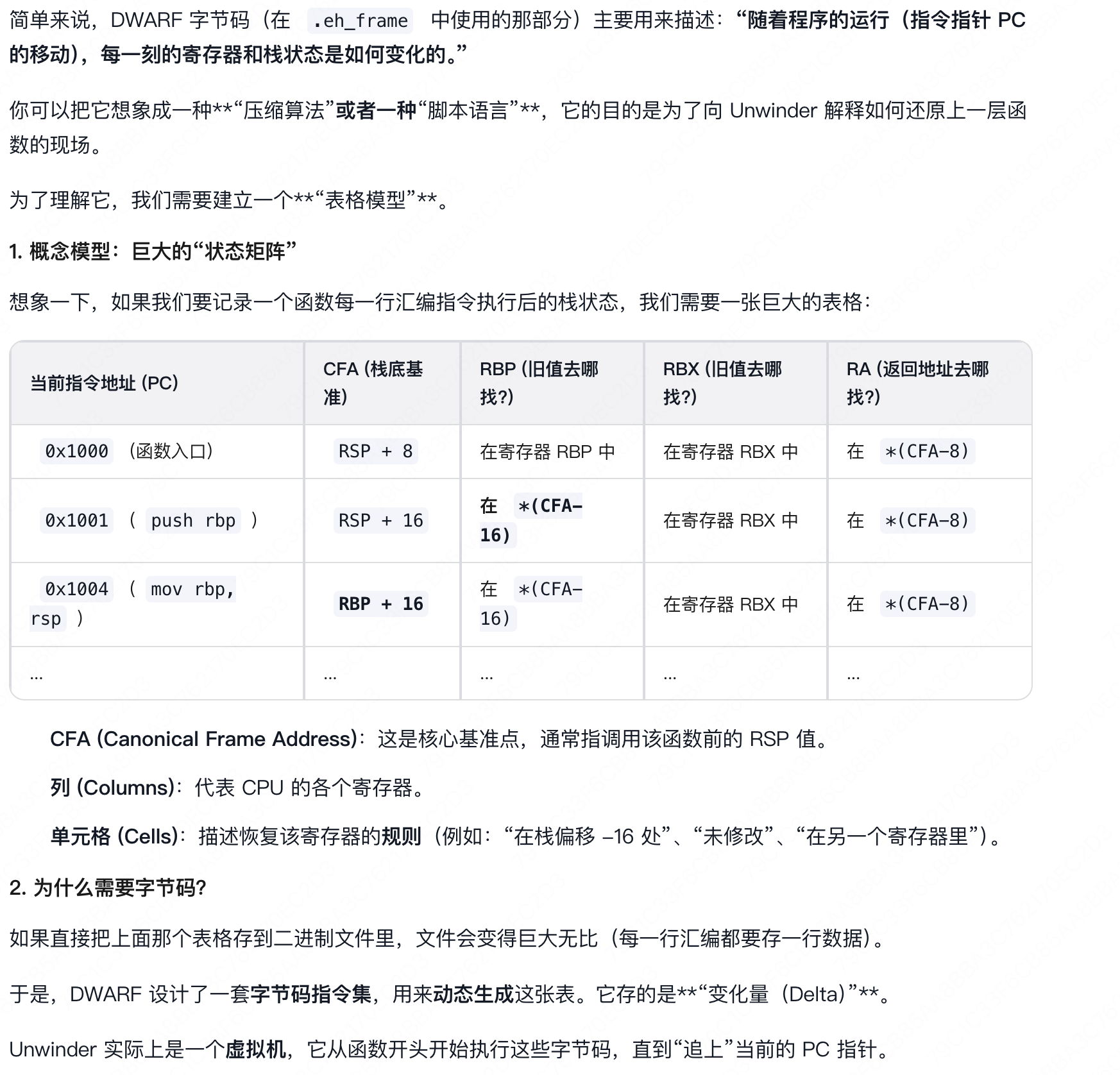
  • decodeFDE / parseFDEInstructions 读 FDE (Frame Description Entry),解释执行 FDE 中的 DWARF 字节码,得到指定 PC 位置对应栈上保存的值的位置偏移量表
    image

  • 拿到栈底基准地址

  • 根据位置偏移量表获取到栈上保存的寄存器的所有值,恢复到拷贝的寄存器状态中

  • 设置 IP 为 returnAddress(跳到上一层函数)

  • 切换寄存器状态 register 为 newRegisters

__unw_get_proc_info

1
2
3
4
5
6
7
8
9
10
11
12
13
14
15
16
17
18
19
20
21
22
23
24
25
26
27
28
29
30
31
32
33
34
35
36
37
38
39
40
41
42
43
44
45
46
47
48
49
50
51
52
53
54
55
56
57
58
59
60
61
62
63
64
65
66
67
68
69
/// Get unwind info at cursor position in stack frame.
_LIBUNWIND_HIDDEN int __unw_get_proc_info(unw_cursor_t *cursor,
unw_proc_info_t *info) {
_LIBUNWIND_TRACE_API("__unw_get_proc_info(cursor=%p, &info=%p)",
static_cast<void *>(cursor), static_cast<void *>(info));
AbstractUnwindCursor *co = (AbstractUnwindCursor *)cursor;
co->getInfo(info);
if (info->end_ip == 0)
return UNW_ENOINFO;
return UNW_ESUCCESS;
}
_LIBUNWIND_WEAK_ALIAS(__unw_get_proc_info, unw_get_proc_info)

template <typename A, typename R>
bool UnwindCursor<A, R>::getInfoFromDwarfSection(
const typename R::link_reg_t &pc, const UnwindInfoSections &sects,
uint32_t fdeSectionOffsetHint) {
typename CFI_Parser<A>::FDE_Info fdeInfo;
typename CFI_Parser<A>::CIE_Info cieInfo;
bool foundFDE = false;
bool foundInCache = false;
// If compact encoding table gave offset into dwarf section, go directly there
if (fdeSectionOffsetHint != 0) {
foundFDE = CFI_Parser<A>::findFDE(_addressSpace, pc, sects.dwarf_section,
sects.dwarf_section_length,
sects.dwarf_section + fdeSectionOffsetHint,
&fdeInfo, &cieInfo);
}
#if defined(_LIBUNWIND_SUPPORT_DWARF_INDEX)
if (!foundFDE && (sects.dwarf_index_section != 0)) {
foundFDE = EHHeaderParser<A>::findFDE(
_addressSpace, pc, sects.dwarf_index_section,
(uint32_t)sects.dwarf_index_section_length, &fdeInfo, &cieInfo);
}
#endif
if (!foundFDE) {
// otherwise, search cache of previously found FDEs.
pint_t cachedFDE = DwarfFDECache<A>::findFDE(sects.dso_base, pc);
if (cachedFDE != 0) {
foundFDE =
CFI_Parser<A>::findFDE(_addressSpace, pc, sects.dwarf_section,
sects.dwarf_section_length,
cachedFDE, &fdeInfo, &cieInfo);
foundInCache = foundFDE;
}
}
if (!foundFDE) {
// Still not found, do full scan of __eh_frame section.
foundFDE = CFI_Parser<A>::findFDE(_addressSpace, pc, sects.dwarf_section,
sects.dwarf_section_length, 0,
&fdeInfo, &cieInfo);
}
if (foundFDE) {
if (getInfoFromFdeCie(fdeInfo, cieInfo, pc, sects.dso_base)) {
// Add to cache (to make next lookup faster) if we had no hint
// and there was no index.
if (!foundInCache && (fdeSectionOffsetHint == 0)) {
#if defined(_LIBUNWIND_SUPPORT_DWARF_INDEX)
if (sects.dwarf_index_section == 0)
#endif
DwarfFDECache<A>::add(sects.dso_base, fdeInfo.pcStart, fdeInfo.pcEnd,
fdeInfo.fdeStart);
}
return true;
}
}
//_LIBUNWIND_DEBUG_LOG("can't find/use FDE for pc=0x%llX", (uint64_t)pc);
return false;
}

这段代码主要是在查找 FDE 头:

  • 如果有 fdeSectionOffsetHint,直接根据 fdeSectionOffsetHint 查找

  • 如果没有,利用 .eh_frame_hdr 查找

  • 如果没有,则从缓存中查找,如果这个函数之前 unwind 过,则会被 libunwind 在内存中记录下来

  • 如果缓存中仍然找不到,则全量扫描一遍 .eh_frame

  • 拿到后解析信息并将结果设置到缓存

get_handler_function

1
2
3
4
5
6
7
8
9
10
11
12
13
14
15
16
17
18
19
20
21
22
23
24
25
struct unw_proc_info_t {
unw_word_t __ptrauth_unwind_upi_startip start_ip; /* start address of function */
unw_word_t __ptrauth_unwind_upi_endip end_ip; /* address after end of function */
unw_word_t __ptrauth_unwind_upi_lsda lsda; /* address of language specific data area, */
/* or zero if not used */

unw_word_t __ptrauth_unwind_upi_handler_intptr handler;
unw_word_t gp; /* not used */
unw_word_t __ptrauth_unwind_upi_flags flags; /* not used */
uint32_t format; /* compact unwind encoding, or zero if none */
uint32_t unwind_info_size; /* size of DWARF unwind info, or zero if none */
unw_word_t __ptrauth_unwind_upi_info unwind_info; /* address of DWARF unwind info, or zero */
unw_word_t __ptrauth_unwind_upi_extra extra; /* mach_header of mach-o image containing func */
};

static _Unwind_Personality_Fn get_handler_function(unw_proc_info_t *frameInfo) {
uintptr_t __unwind_ptrauth_restricted_intptr(ptrauth_key_function_pointer,
0,
ptrauth_function_pointer_type_discriminator(_Unwind_Personality_Fn))
reauthenticatedIntegerHandler = frameInfo->handler;
_Unwind_Personality_Fn handler;
memmove(&handler, (void *)&reauthenticatedIntegerHandler,
sizeof(_Unwind_Personality_Fn));
return handler;
}

从 FDE 头中拿到 handler 代码段,将其拷贝并返回,看起来 handler 代码段应该是固定长度,可以 alloc 在栈上。

clean up phase

1
2
3
4
5
6
7
8
9
10
11
12
13
14
15
16
17
18
19
20
21
22
23
24
25
26
27
28
29
30
31
32
33
34
35
36
37
38
39
40
41
42
43
44
45
46
47
48
49
50
51
52
53
54
55
56
57
58
59
60
61
62
63
64
65
66
67
68
69
70
71
72
73
74
75
76
77
78
79
80
81
82
83
84
85
86
87
88
89
90
91
92
93
94
95
96
97
98
99
100
101
102
103
104
105
106
107
108
109
110
111
112
113
114
115
116
117
118
119
120
121
122
123
124
125
126
127
128
129
130
131
132
133
134
135
136
137
138
139
static _Unwind_Reason_Code
unwind_phase2(unw_context_t *uc, unw_cursor_t *cursor,
_Unwind_Exception *exception_object) {
__unw_init_local(cursor, uc);

_LIBUNWIND_TRACE_UNWINDING("unwind_phase2(ex_obj=%p)",
(void *)exception_object);

// uc is initialized by __unw_getcontext in the parent frame. The first stack
// frame walked is unwind_phase2.
unsigned framesWalked = 1;
#if defined(_LIBUNWIND_USE_CET)
unsigned long shadowStackTop = _get_ssp();
#elif defined(_LIBUNWIND_USE_GCS)
unsigned long shadowStackTop = 0;
if (__chkfeat(_CHKFEAT_GCS))
shadowStackTop = (unsigned long)__gcspr();
#endif
// Walk each frame until we reach where search phase said to stop.
while (true) {

// Ask libunwind to get next frame (skip over first which is
// _Unwind_RaiseException).
int stepResult = __unw_step_stage2(cursor);
if (stepResult == 0) {
_LIBUNWIND_TRACE_UNWINDING(
"unwind_phase2(ex_obj=%p): __unw_step_stage2() reached "
"bottom => _URC_END_OF_STACK",
(void *)exception_object);
return _URC_END_OF_STACK;
} else if (stepResult < 0) {
_LIBUNWIND_TRACE_UNWINDING(
"unwind_phase2(ex_obj=%p): __unw_step_stage2 failed => "
"_URC_FATAL_PHASE1_ERROR",
(void *)exception_object);
return _URC_FATAL_PHASE2_ERROR;
}

// Get info about this frame.
unw_word_t sp;
unw_proc_info_t frameInfo;
__unw_get_reg(cursor, UNW_REG_SP, &sp);
if (__unw_get_proc_info(cursor, &frameInfo) != UNW_ESUCCESS) {
_LIBUNWIND_TRACE_UNWINDING(
"unwind_phase2(ex_obj=%p): __unw_get_proc_info "
"failed => _URC_FATAL_PHASE1_ERROR",
(void *)exception_object);
return _URC_FATAL_PHASE2_ERROR;
}

#ifndef NDEBUG
// When tracing, print state information.
if (_LIBUNWIND_TRACING_UNWINDING) {
char functionBuf[512];
const char *functionName = functionBuf;
unw_word_t offset;
if ((__unw_get_proc_name(cursor, functionBuf, sizeof(functionBuf),
&offset) != UNW_ESUCCESS) ||
(frameInfo.start_ip + offset > frameInfo.end_ip))
functionName = ".anonymous.";
_LIBUNWIND_TRACE_UNWINDING("unwind_phase2(ex_obj=%p): start_ip=0x%" PRIxPTR
", func=%s, sp=0x%" PRIxPTR ", lsda=0x%" PRIxPTR
", personality=0x%" PRIxPTR,
(void *)exception_object, frameInfo.start_ip,
functionName, sp, frameInfo.lsda,
frameInfo.handler);
}
#endif

// In shadow stack enabled environment, we check return address stored in normal
// stack against return address stored in shadow stack, if the 2 addresses don't
// match, it means return address in normal stack has been corrupted, we return
// _URC_FATAL_PHASE2_ERROR.
#if defined(_LIBUNWIND_USE_CET) || defined(_LIBUNWIND_USE_GCS)
if (shadowStackTop != 0) {
unw_word_t retInNormalStack;
__unw_get_reg(cursor, UNW_REG_IP, &retInNormalStack);
unsigned long retInShadowStack =
*(unsigned long *)(shadowStackTop + __shstk_step_size * framesWalked);
if (retInNormalStack != retInShadowStack)
return _URC_FATAL_PHASE2_ERROR;
}
#endif
++framesWalked;
// If there is a personality routine, tell it we are unwinding.
if (frameInfo.handler != 0) {
_Unwind_Personality_Fn p = get_handler_function(&frameInfo);
_Unwind_Action action = _UA_CLEANUP_PHASE;
if (sp == exception_object->private_2) {
// Tell personality this was the frame it marked in phase 1.
action = (_Unwind_Action)(_UA_CLEANUP_PHASE | _UA_HANDLER_FRAME);
}
_Unwind_Reason_Code personalityResult =
(*p)(1, action, exception_object->exception_class, exception_object,
(struct _Unwind_Context *)(cursor));
switch (personalityResult) {
case _URC_CONTINUE_UNWIND:
// Continue unwinding
_LIBUNWIND_TRACE_UNWINDING(
"unwind_phase2(ex_obj=%p): _URC_CONTINUE_UNWIND",
(void *)exception_object);
if (sp == exception_object->private_2) {
// Phase 1 said we would stop at this frame, but we did not...
_LIBUNWIND_ABORT("during phase1 personality function said it would "
"stop here, but now in phase2 it did not stop here");
}
break;
case _URC_INSTALL_CONTEXT:
_LIBUNWIND_TRACE_UNWINDING(
"unwind_phase2(ex_obj=%p): _URC_INSTALL_CONTEXT",
(void *)exception_object);
// Personality routine says to transfer control to landing pad.
// We may get control back if landing pad calls _Unwind_Resume().
if (_LIBUNWIND_TRACING_UNWINDING) {
unw_word_t pc;
__unw_get_reg(cursor, UNW_REG_IP, &pc);
__unw_get_reg(cursor, UNW_REG_SP, &sp);
_LIBUNWIND_TRACE_UNWINDING("unwind_phase2(ex_obj=%p): re-entering "
"user code with ip=0x%" PRIxPTR
", sp=0x%" PRIxPTR,
(void *)exception_object, pc, sp);
}

__unw_phase2_resume(cursor, framesWalked);
// __unw_phase2_resume() only returns if there was an error.
return _URC_FATAL_PHASE2_ERROR;
default:
// Personality routine returned an unknown result code.
_LIBUNWIND_DEBUG_LOG("personality function returned unknown result %d",
personalityResult);
return _URC_FATAL_PHASE2_ERROR;
}
}
}

// Clean up phase did not resume at the frame that the search phase
// said it would...
return _URC_FATAL_PHASE2_ERROR;
}
  • 向下遍历栈帧

  • 获取当前栈帧信息 (__unw_get_proc_info)

  • 如果当前栈帧有 handler(即有 catch clause 或需要析构的 RAII 对象),则执行这个 handler

  • 如果是 catch 代码块,会直接通过修改 IP 跳转到 catch 块,所以函数不会返回。

  • 如果是析构 RAII object,也会通过 __unw_phase2_resume 跳转到 landing pad,执行析构函数后调用 _Unwind_Resume 跳回 Unwinder。

__unw_step_stage2

跟前面 _unw_step 其实是一样的,只是 arm64 架构会有特殊处理。

__unw_phase2_resume

1
2
3
4
5
6
7
8
9
10
11
12
13
#define __unw_phase2_resume(cursor, payload)                                   \
do { \
_LIBUNWIND_POP_SHSTK_SSP((payload)); \
void *shstkRegContext = __libunwind_shstk_get_registers((cursor)); \
void *shstkJumpAddress = __libunwind_shstk_get_jump_target(); \
__asm__ volatile("mov x0, %0\n\t" \
"mov x1, #0\n\t" \
"br %1\n\t" \
: \
: "r"(shstkRegContext), "r"(shstkJumpAddress) \
: "x0", "x1"); \
} while (0)
#endif

__unw_phase2_resume 是一个宏,会跳到一个 trampoline,trampoline 会把 x0 中保存的寄存器状态(即 shstkRegContext)恢复到寄存器(包括 ip),此时就算成功跳转到 Landing Pad 了。

Landing pad

Landing pad 中执行完析构函数后,会调用 _Unwind_Resume 跳转回 unwind 逻辑。

1
2
3
4
5
6
7
8
9
10
11
12
13
14
15
16
17
_LIBUNWIND_EXPORT void
_Unwind_Resume(_Unwind_Exception *exception_object) {
_LIBUNWIND_TRACE_API("_Unwind_Resume(ex_obj=%p)", (void *)exception_object);
unw_context_t uc;
unw_cursor_t cursor;
__unw_getcontext(&uc);

if (exception_object->private_1 != 0)
unwind_phase2_forced(&uc, &cursor, exception_object,
(_Unwind_Stop_Fn) exception_object->private_1,
(void *)exception_object->private_2);
else
unwind_phase2(&uc, &cursor, exception_object);

// Clients assume _Unwind_Resume() does not return, so all we can do is abort.
_LIBUNWIND_ABORT("_Unwind_Resume() can't return");
}

其实就是重新调用了一下 unwind_phase2 ,因为 unwind_phase2 里面是一个死循环的结构,所以恢复只需要再次调用就可以了,想到了 Kotlin 协程,思路挺像的。

至于参数就获取当前的寄存器快照就可以了,当前的sp其实就在当前 Landing pad 对应栈帧的下面一个栈帧,是 Landing pad 这个函数自己开辟的。

将这个寄存器快照传给 unwind_phase2,它所做的第一件事就是往上找一层,就找到了当前 Landing pad 对应的栈帧。

unwind_phase2 是通过 IP 来查找对应的 handler 的,当从 Landing pad 调用 unwind_phase2 时,IP 已经位于函数的末尾(Landing pad 就位于函数的末尾),所以会直接放行,不会查到第一次进入时 handler。

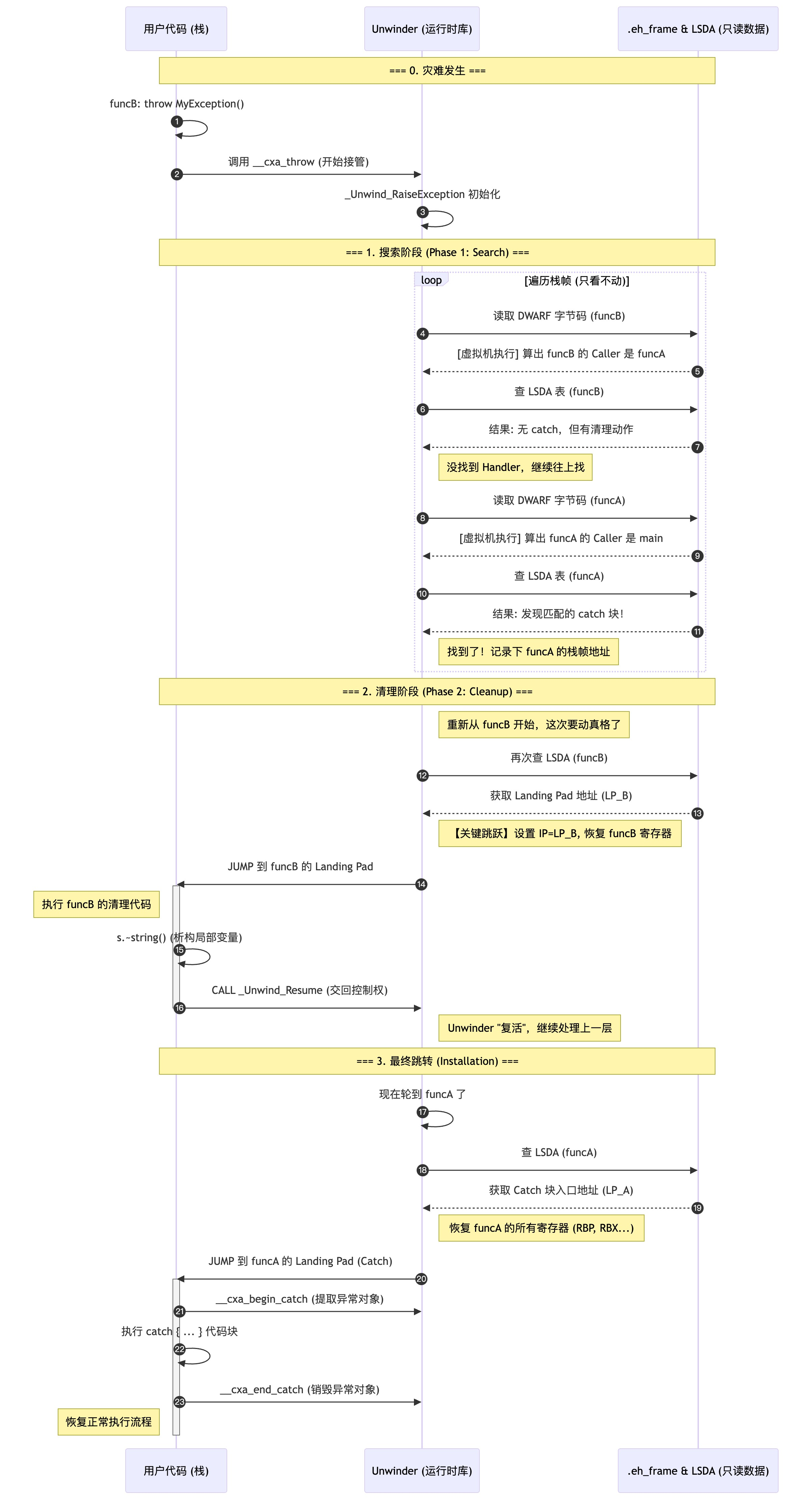
AI 生成的流程图
image

评论